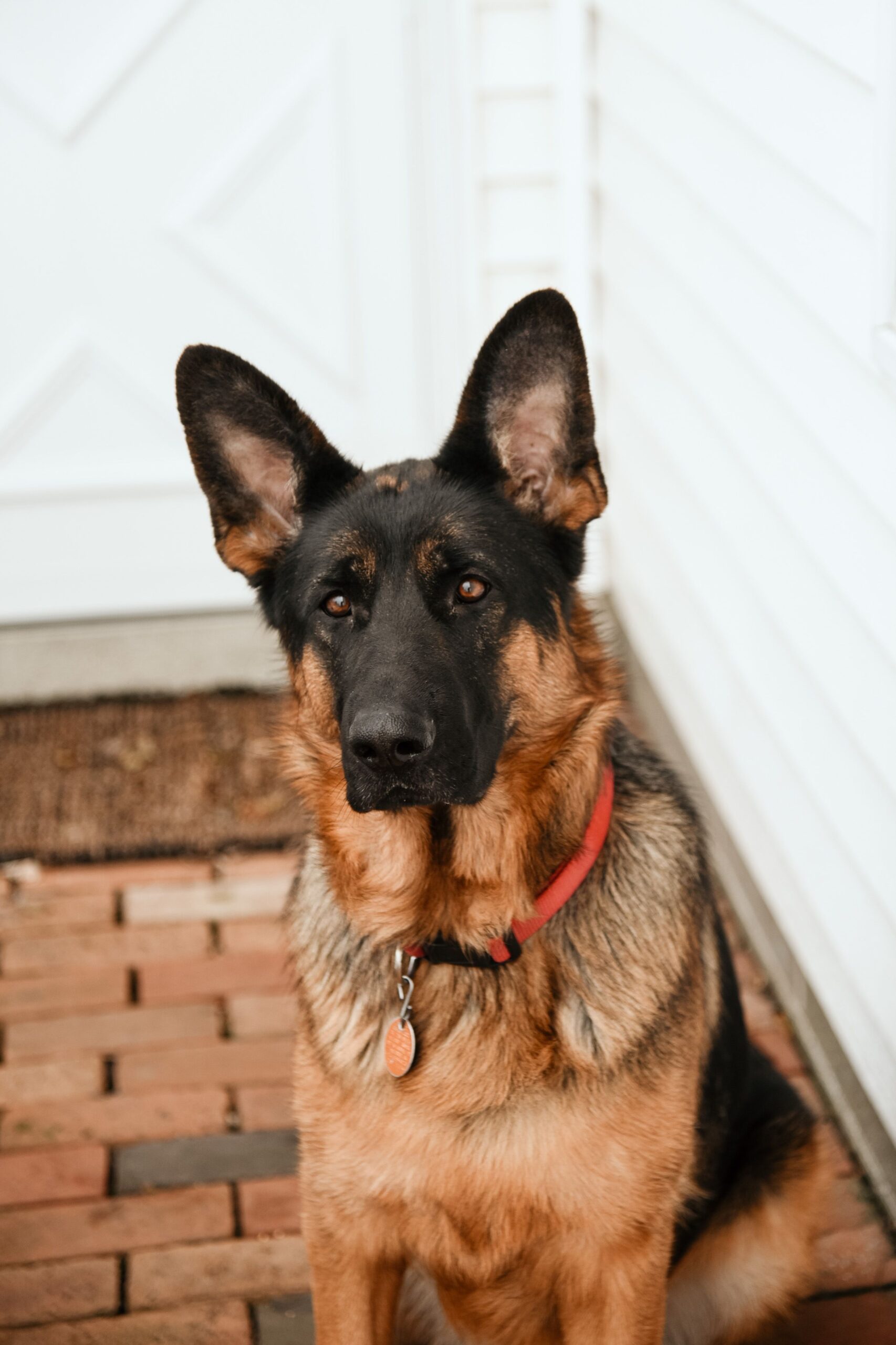
How to Stop a German Shepherd from Pulling on the Leash (The Honest Version)
I used to dread walks.
I want to sit with that sentence for a second, because if you’d told me before I got a German Shepherd that I would dread walking my dog, I would have laughed. Walks were the thing I was most excited about. Morning walks, evening walks, weekend hikes — the whole vision of life with a big, beautiful dog, moving through the world together.
What I did not envision was Ranger — my now four-year-old German Shepherd — converting me into a human water ski. Both arms extended in front of me, leaning back at a 30-degree angle, being dragged down the sidewalk at a pace that would embarrass a competitive speed-walker, while neighbors watched from their driveways with an expression somewhere between concern and entertainment.
I tried everything I could find online. I spent money on equipment that promised results it didn’t deliver. I got advice from people at the dog park that actively made things worse. I had a brief, dark period where I genuinely considered whether Ranger just wasn’t a dog who could go on walks.
He absolutely is. He walks beautifully now — loose leash, checking in with me, matching my pace. I can hold the leash with two fingers on a casual evening.
Here is everything that actually worked, and a complete record of everything that didn’t.
Why German Shepherds Pull: Understanding Before Fixing
The single most important reframe I made — the one that changed everything about my approach — was understanding why Ranger was pulling, rather than just trying to stop the behavior as if it were a switch I needed to find.
German Shepherds pull for the same reason they do most things at high intensity: they are driven, energetic, and deeply motivated by the environment around them. When you clip that leash on, you are attaching yourself to an animal whose nose is picking up approximately a thousand times more information per second than yours, whose arousal immediately elevates at the prospect of outside, and who has a body built for sustained physical effort.
The leash is, from the dog’s perspective, an inconvenience. The world is out there. Let’s go.
This isn’t dominance. It isn’t the dog “not respecting you.” It isn’t a character flaw that speaks to some deeper problem in your relationship. It is a high-drive animal doing what high-drive animals do when their brain is flooded with interesting input and their legs are fully capable of running toward it.
The reason this matters is that it determines your strategy. If you think pulling is about dominance, you’ll try dominance-based corrections — jerking, alpha rolls, punitive tools — that at best don’t work and at worst damage your relationship and create fear and reactivity. If you understand it as a management and training challenge, you approach it completely differently.
You’re not fighting for authority. You’re teaching a skill.
The Gear Conversation Nobody Has Honestly Enough
Let me be straightforward about equipment, because this is where most people spend money they don’t need to spend on things that don’t solve the underlying problem.
Standard flat collar: For a determined German Shepherd puller, a flat collar is fine once they’ve learned to walk nicely. Before that, it transfers all the pulling force to the dog’s neck and trachea, which is uncomfortable for them and potentially harmful over time. It also gives you essentially no mechanical advantage on a 75-pound dog who wants to be somewhere else.
Retractable leash: If you are using a retractable leash to try to teach loose-leash walking, please put it in a drawer and leave it there. Retractable leashes teach dogs that pulling extends their range, which is the exact opposite of what you want. They are wonderful for giving a trained dog controlled freedom to sniff. They are counterproductive for teaching anything about leash pressure.
Prong collar / choke chain: I know people use these and some will swear by them. I tried a prong collar with Ranger for three weeks on the advice of someone at a training class. It made him walk more tensely, made him more reactive toward other dogs (pain-based corrections during trigger exposure is a reliable recipe for creating negative associations), and the moment the collar came off, he was pulling exactly as before. It managed the symptom during application without teaching anything. Not for us, and not something I’d recommend for a breed as sensitive as a GSD.
No-pull harness (front clip): This is where things got genuinely useful for us. A front-clip harness attaches the leash at the dog’s chest rather than their back, which means when they pull forward, the attachment point redirects them to the side rather than just letting them drag you. It doesn’t stop pulling by itself — the dog still pulls, you’re just better positioned to handle it — but it gives you a mechanical advantage while you do the actual training. Used correctly, it’s a management tool that makes the training window accessible, not a substitute for the training.
Head halter (Gentle Leader / Halti): Works on the same principle as a horse halter — control the head, influence the direction of the body. Very effective for strong pullers once the dog is acclimated to wearing it, which takes patient introduction because most dogs absolutely hate the sensation at first. Ranger wore a Halti for about four months during the heavy training phase and it genuinely helped me maintain enough control to reward the good behavior I was looking for.
The honest answer on equipment: tools help you manage pulling while you train. They do not teach loose-leash walking. The teaching is the work.
What Actually Teaches Loose-Leash Walking
Here’s the core of it, without the complicated language.
Loose-leash walking is a trained behavior, like sit or down. It does not come naturally to dogs. There is nothing instinctive about matching the pace of a slower bipedal creature when the world is full of interesting things. Every dog that walks nicely on a leash was taught to do so. Including the ones that make it look effortless.
The teaching works on one fundamental principle: tension on the leash never results in forward progress.
The moment Ranger pulls and the leash goes tight — the walk stops. Every time, without exception. I stop moving. I wait. The second the leash softens — any slack at all — we move forward again.
That’s it. That’s the whole thing.
The challenge is that this requires extraordinary consistency, substantial patience, and a willingness to have walks that are, in the early stages, extremely slow and frustrating. On our first proper training walk, we covered about a quarter mile in forty minutes. I stopped and started approximately four hundred times. A woman walking past us with her labrador said “training day?” with a knowing smile. I said yes through slightly gritted teeth.
But here’s what was happening during those stops: Ranger was learning. Every time the leash went tight and we stopped, the information “tension = no forward movement” was registering. Every time the leash softened and I said “yes!” and we moved forward again, the information “loose leash = progress” was registering. I was programming a new response to leash pressure, one repetition at a time.
The Methods I Used, In Order of Introduction
Method 1: Stop-and-Wait (The Foundation)
As described above. Leash tight, stop walking. Leash loose, walk forward. No drama, no correction, no frustration expressed verbally (harder than it sounds). Just the consistent consequence applied every single time.
The key word is every. Once is not training. Fifty times is not training. The behavior changes when the rule is applied so consistently that the dog’s brain has no choice but to update its model of how the world works.
If you stop nine times and let the tenth pull go because you’re tired, you’ve just taught your dog that pulling sometimes works, which means they should keep trying.
Method 2: Direction Changes
Once Ranger understood that tension stopped forward movement, I added direction changes. When he pulled forward, instead of just stopping, I’d turn and walk the opposite direction. Or turn 90 degrees. Or simply pivot and walk a few steps back the way we came.
This had two effects. First, it interrupted the forward momentum more decisively than stopping did. Second, it repositioned me in Ranger’s awareness — suddenly I was the source of where we were going, not an obstacle between him and where he wanted to be. He had to start paying attention to me to figure out what direction we were actually moving.
The direction changes were also secretly a lesson in attention. To anticipate my direction changes and not get pulled off balance, Ranger had to watch me. And a dog who is watching you is a dog you can work with.
Method 3: The “Penalty Yard”
This one I learned from a trainer and it sounds punitive but is actually just a clear consequence. When Ranger pulled, I stopped, and then I took a few deliberate steps backward — in the opposite direction of where he wanted to go. The pulling cost him ground rather than just stopping forward progress.
For a dog as motivated by forward movement as Ranger, losing ground was significantly more effective than merely stopping. He found it genuinely annoying, in the best possible way.
Method 4: Rate of Reinforcement
This is the one people underestimate. High rate of reinforcement — meaning frequent rewards for the behavior you want — is what makes loose-leash walking actually stick rather than being something the dog does until they see something interesting.
I carried excellent treats on every walk for the first four months. Not kibble. Actual high-value food — small pieces of chicken, cheese, whatever I knew Ranger found genuinely motivating. Every few seconds that the leash was loose, I’d mark it (“yes!”) and either give a treat or give enthusiastic verbal praise. I was making loose-leash walking feel like a slot machine that paid out regularly.
What this does neurologically is build a positive emotional state around the loose-leash behavior. It’s not just “I don’t pull because pulling doesn’t work.” It’s “I walk nicely because walking nicely has been fantastic and rewarding and I enjoy this.”
The second framing produces a much more reliable, durable behavior.
The Things That Undermined My Progress
I want to be honest about the setbacks, because I made real mistakes and they cost me weeks.
Inconsistency between family members. My brother-in-law visited for two weeks and walked Ranger every morning. He let Ranger pull the whole time because “it’s fine, I don’t mind.” Those two weeks put me back almost a month in training. If other people are walking your dog, they need to apply the same rules. There’s no shortcut around this.
This is deeply connected to the single-person bonding dynamic that anyone with a German Shepherd will recognize — Ranger knew exactly which humans would enforce the rules and which ones wouldn’t, the same way he knew which family member was his person and adjusted his behavior accordingly, just like what happens with German Shepherds who are obsessed with one family member. Dogs are excellent at reading people and adapting their behavior to specific individuals.
Walking when he hadn’t been exercised enough. A Ranger who had been cooped up all day and was at peak arousal was not in a learning state during walks. His brain was so flooded with stored-up energy that he couldn’t access the parts that made good decisions. On those days, no training was happening — I was just being dragged.
The solution was to take the edge off first. A backyard play session, some training exercises, a short run in an open space — something to lower his arousal baseline before the leash went on. A tired German Shepherd is not a perfect German Shepherd, but a tired German Shepherd is significantly more capable of learning than a fully wound-up one. This principle applies to almost everything with this breed — whether you’re working on leash manners, managing guarding behavior, or helping them through noise fears.
Expecting too much too soon in high-distraction environments. I took Ranger to a busy park to practice loose-leash walking before he had truly nailed it in low-distraction settings. The park had dogs, children, squirrels, and smells from approximately every food group. He pulled like I wasn’t even there. I got frustrated. He got more aroused. Nothing useful happened.
Distraction levels need to be managed like a gradient. Master the quiet street before the neighborhood. Master the neighborhood before the park entrance. Master the park entrance before the park itself. Each step only happens when the previous one is solid.
Letting myself get emotional about it. German Shepherds read emotional states with uncomfortable precision. When I was frustrated, Ranger knew. When I was tense before the walk even started — bracing myself, gripping the leash too tight — he felt it and it elevated his arousal. My anxiety fed his. The single most useful physical habit I built was loosening my grip on the leash intentionally before walks began. Relaxed hand, relaxed dog. Not completely, not immediately, but over time the correlation was real.
This is the same dynamic I noticed when dealing with his other big behaviors — his pawing intensified when I was stressed, his play got rougher when I was frantic. GSDs are mirrors. Whatever you bring to an interaction is going to show up in them.
The “Sniff Walk” Concept That Changed Everything
Somewhere around month three, I had a conversation with a certified trainer that shifted my whole understanding of what walks are for.
I had been treating walks as exercise, primarily. Get Ranger out, burn energy, come home. The loose-leash training was a thing I was trying to accomplish during the exercise.
She pointed out that for dogs, sniffing is not a bonus feature of the walk. It’s the primary experience. The information a dog gets through their nose on a twenty-minute walk through the neighborhood is mentally exhausting in the best way — it’s the equivalent of reading a really gripping novel. Dogs that get adequate sniff time are calmer, more satisfied, and more trainable than dogs that are marched along without the opportunity to engage with their environment.
So I split walks into two types.
Training walks: Shorter, on a specific route, structured. Loose-leash rules apply strictly. Treats in my pocket, attention on Ranger, working the stop-and-wait and direction changes consistently.
Sniff walks: Longer, on a long line or in an open space, with a specific cue (“go sniff”) that signals Ranger he can range and investigate freely. No loose-leash requirement. This is his time.
This separation did several things. It gave Ranger a proper mental outlet, which lowered his overall arousal level and made the training walks more productive. It also clarified the communication — the leash-on-harness training walk meant something specific, and Ranger learned to read the context. On sniff walks, he moved freely. On training walks, he attended to me.
When Other Behavior Problems Are Connected to the Leash
Something I noticed as the leash pulling improved: other behaviors improved alongside it, without me specifically working on them.
Ranger’s reactivity toward other dogs on walks — which had been a secondary issue I was dreading addressing — reduced significantly as the loose-leash training progressed. I think what happened is that the training process itself built his focus on me during walks, which meant he was oriented toward me rather than laser-focused on everything in the environment. A dog that’s checking in with you periodically is a dog you can redirect when a trigger appears.
This is worth knowing because leash behavior doesn’t exist in isolation. It’s part of a whole picture of how a dog moves through the world. The same dog that chases cats with single-minded focus or growls during play with theatrical intensity is going to bring that same drive to the end of a leash. Working on general focus, impulse control, and the relationship between you and your dog transfers across contexts in ways that targeted training on individual behaviors doesn’t always predict.
German Shepherds especially — because of their intelligence and their attunement to their handlers — respond to the meta-lesson underneath specific training: that their person is worth paying attention to.
The Genetics Angle: Why Some GSDs Are Harder Than Others
Not all German Shepherds pull with the same intensity, and it’s worth understanding why.
Working-line German Shepherds — the ones bred for police, military, and sport — have significantly higher drive than show-line dogs. They were selected, specifically and deliberately, for the kind of forward, relentless motivation that makes them extraordinary in working roles and occasionally makes them absolute tornadoes on a leash in civilian life.
If you have a working-line GSD, or any dog with high working drive, the leash training timeline is longer, the consistency required is greater, and the exercise demands are higher. This isn’t a reflection of how much you’ve done wrong — it’s a reflection of what the dog was bred to do.
Understanding the genetic basis of drive and temperament in German Shepherds goes deeper than most people realize — it shapes not just energy level but the whole profile of how the dog experiences and responds to the world. The genetics of the GSD breed are fascinating in this respect, because you start to see how much of what feels like individual personality is actually deeply breed-specific and line-specific patterning.
Where Ranger Is Now
Four years in, two and a half of them with intentional work on leash manners, this is what walks look like:
Ranger walks on my left side, roughly at my knee. The leash makes a gentle J-shape between us — loose, no tension. When something interesting appears — a dog, a cat, a smell that requires investigation — he might drift toward it, feel the leash go slightly taut, and orient back to me. Most of the time without me saying anything.
When I stop, he stops. When I turn, he follows. When I speed up, he speeds up.
We walk for an hour most mornings. I hold the leash in one hand, usually with my coffee in the other. It looks effortless. It was not effortless. It was months of cold mornings and slow progress and consistency that I maintained on days when I really did not want to.
But I’d do it again in a heartbeat. Those morning walks with Ranger are now the best part of my day.
That turnaround — from dreading walks to them being the thing I look forward to most — is the part I most want you to believe is possible for you.
It is. It just takes longer than anyone tells you, and more consistency than feels reasonable at the time, and a genuine understanding of the animal at the other end of the leash.
Start there. Everything else follows.
Have a question about a specific leash behavior challenge — reactivity, lunging, specific triggers? Drop it in the comments. Every dog is a different puzzle, and sometimes thinking out loud about the specifics makes all the difference.