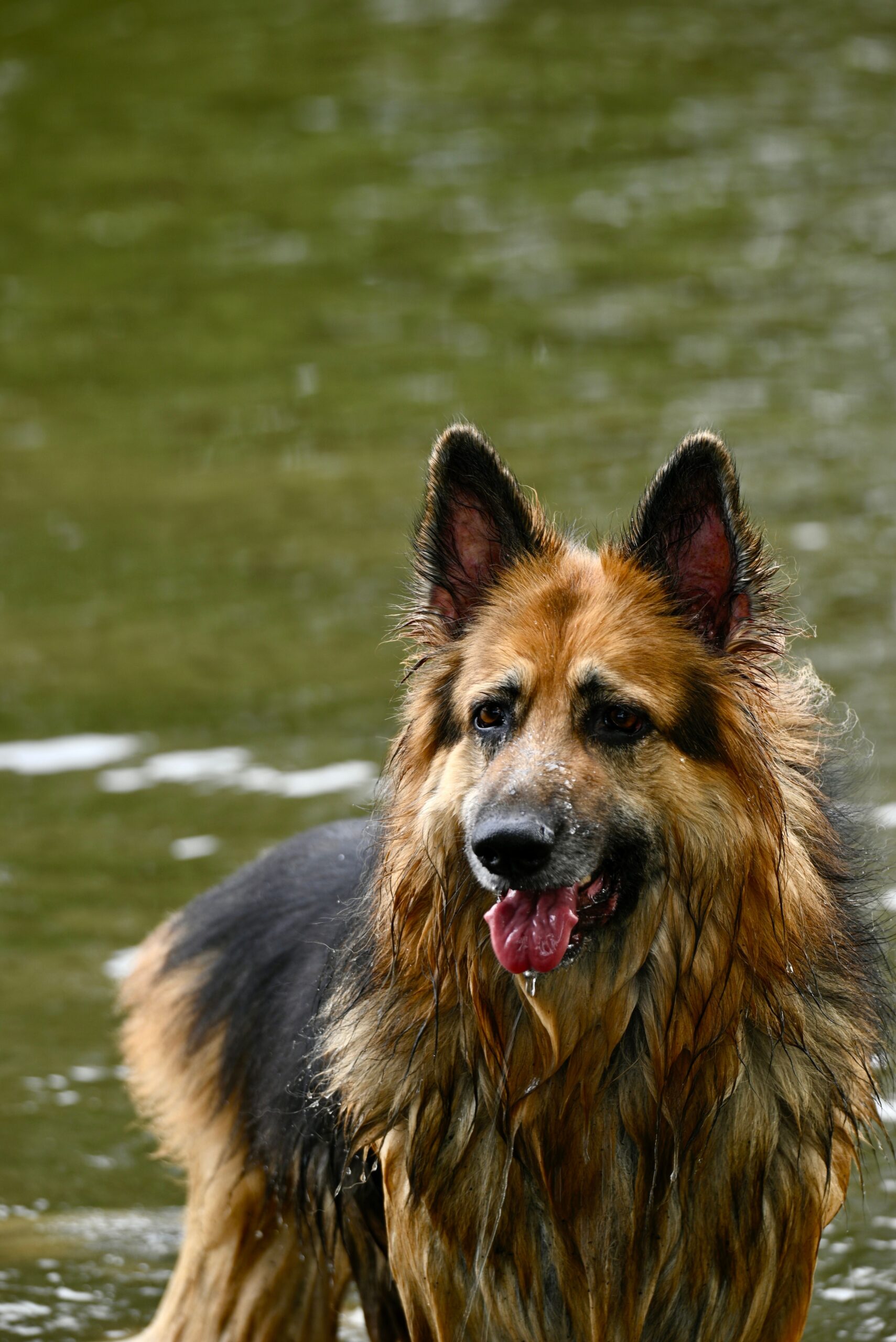
German Shepherd Obsessed with One Family Member? Here’s the Truth Nobody Tells You
My husband thinks Kaiser chose me because I’m “the fun one.”
My husband is wrong. But I’ve let him believe it for four years because the truth is more complicated, a little embarrassing, and requires explaining canine bonding psychology to a man who largely communicates in sports metaphors.
Here’s what actually happened: Kaiser — our now five-year-old German Shepherd — decided within the first two weeks of coming home that I was his person. Not in a “favorite family member” way. In a “I will follow you to the bathroom, sleep outside the bathroom door, and be waiting when you come out with the expression of someone who has survived a great ordeal” way.
My husband feeds Kaiser breakfast every single morning. He walks him on weekends. He genuinely loves that dog, and the feeling is — politely — somewhat returned. Kaiser will wag when my husband comes home. He’ll take treats from him. He’ll sit nearby when they’re watching TV together.
But when I walk into the room, Kaiser moves.
He reorients entirely. Whatever he was doing — sleeping, chewing, existing — pauses, and he tracks me the way a sunflower tracks light. It’s flattering and slightly unnerving and has caused a number of dinnertime conversations in our house about “the dog’s attachment issues.”
If this sounds familiar — if your German Shepherd has locked onto one person in your household with an intensity that borders on devotion — welcome. Let’s talk about why this happens, what it means, and how to make sure it works for your whole family rather than creating a divided household.
First, Let Me Reassure You: This Is Incredibly Normal
German Shepherds are not golden retrievers.
I say that with full respect for golden retrievers, who are wonderful, warm, democratically affectionate animals that love everyone in the room approximately equally and make every human feel like the most important person alive.
German Shepherds are different. They are, at their core, a breed built for partnership with one person. The history of the breed is the history of a working dog and their handler — one dog, one human, a specific bond built around a specific shared purpose. Herding, protection, military work, police service — in almost every traditional GSD role, the dog answers to one person. That’s not a design flaw. It’s a feature, engineered over generations.
When your German Shepherd “chooses” one family member, they’re not being rude to everyone else. They’re being exactly what they were bred to be. A dog with a person.
The interesting question — the one worth digging into — is how they choose.
How German Shepherds Actually Pick Their Person
This is the part my husband refuses to accept, because it implicates him pretty directly.
Dogs don’t choose their favorite person based on who loves them most. They don’t even particularly choose based on who spends the most time with them, though that’s a factor. German Shepherds, specifically, tend to bond most deeply with the person who:
Communicates most clearly with them. German Shepherds are extraordinarily sensitive to human communication — body language, tone of voice, consistency of signals. The person in the household who is clearest, most consistent, and most readable tends to earn the deepest trust. It’s not about dominance or “being the alpha” — it’s about being comprehensible. A dog can relax with someone they understand.
Has done the most training with them. Training is, at its core, a conversation. It requires attention, responsiveness, and reciprocity from both parties. When you train a German Shepherd — particularly with positive, reward-based methods — you’re not just teaching commands. You’re building a communication system, and that system creates closeness. Kaiser went through obedience training with me. My husband did not attend a single class. I’m not saying that’s the whole story, but it is a story.
Matches their energy. German Shepherds read energy acutely. If you are calm, consistent, and confident, your GSD will find you deeply reassuring. If you are anxious, unpredictable, or high-strung (no judgment — I have my moments), your dog may actually be less drawn to spend time near you, because you’re adding to their arousal rather than regulating it.
Was most present during the critical socialization window. If your GSD came home as a puppy and one family member was working from home while another was at the office, the dog who bonded during those first months in the house is going to carry a disproportionate piece of the primary bond — possibly forever.
Responds most consistently to their communication attempts. When Kaiser paws at me, I respond. Not always in the way he wants, but I respond — I acknowledge, I check what he needs, I engage. My husband tends to absentmindedly pat him and go back to whatever he was doing. From Kaiser’s perspective, I’m the more reliable communicator. Of course he’s going to orient toward that.
What “Obsession” Actually Looks Like (And the Spectrum It Exists On)
Not all single-person bonding looks the same. There’s a wide range between “clear preference” and “cannot function when separated,” and where your dog falls on that spectrum matters enormously for how you approach it.
Normal, Healthy Single-Person Bonding
The dog clearly prefers one person but functions normally around the rest of the family. They greet everyone, accept handling from everyone, can be cared for by other family members without distress, and are generally well-adjusted — just with a clear favorite.
Kaiser is here. He’s a one-person dog in the way that a person might have a best friend: the relationship has special depth, but it doesn’t preclude other connections.
Mild to Moderate Velcro Behavior
The dog follows their person obsessively from room to room, positions themselves to always be in contact or near contact, and shows mild anxiety when the person is out of sight — pacing, watching the door, inability to fully settle until the person returns.
This is common in German Shepherds and is related to their baseline need for proximity to their handler. It’s manageable and doesn’t necessarily indicate a problem, but it’s worth working on gradually for the dog’s quality of life.
Separation-Linked Anxiety
The dog’s attachment to one person is so intense that their absence creates genuine distress — destructive behavior, vocalizing, inability to eat, physiological signs of anxiety (drooling, panting, pacing). This goes beyond preference into dependency, and it’s worth addressing because it makes the dog miserable and puts enormous pressure on the primary bond-person’s life.
Concerning Protective Behavior Toward One Person
Sometimes single-person bonding tips into guarding behavior — the dog not only prefers their person but begins intercepting access, growling when others approach, or behaving in ways that make other family members feel excluded or threatened. This requires intervention because it’s unsafe and unsustainable in a family home.
Knowing which category you’re dealing with shapes everything about how you respond.
The Family Meeting Nobody Has But Everybody Needs
Here’s something I wish someone had told us in the early months with Kaiser: the whole family needs to be part of how you manage a one-person GSD. Because the dog didn’t just affect my relationship with Kaiser. He affected the dynamics of our entire household.
My husband felt slightly stung by Kaiser’s preference, even though he’d never admit it. My kids — we have two, ages nine and twelve — noticed that Kaiser greeted me differently than he greeted them. These things matter. They affect how family members interact with the dog, which in turn affects the dog’s behavior and reinforces the pattern.
If the dog’s favorite person is getting all the bonding experiences — all the walks, all the training, all the play — the gap between their bond and everyone else’s will naturally widen. The family needs to consciously redistribute those experiences if they want the dog to bond more broadly.
Practical changes we made:
My husband took over evening walks exclusively. Not as a chore — as a relationship-building exercise. He learned to do it in a way that was actually engaging for Kaiser: new routes, stopping to let Kaiser sniff, practicing a few commands along the way. Within a month, Kaiser’s greeting of my husband had genuinely warmed. Not to my level, but noticeably more engaged than before.
My kids started being the ones to put Kaiser’s dinner down. Simple, consistent, daily. It repositioned them in Kaiser’s mental map from “enjoyable but optional” to “these small humans are involved in important things.”
I deliberately stepped back in specific contexts. If Kaiser was with my daughter and they were having a nice moment, I stayed out of the room. I was letting that connection develop without me in the picture drawing Kaiser’s attention.
None of this changed who Kaiser’s primary person is. But it made him a dog that is genuinely comfortable with and connected to the whole family, rather than a dog who tolerates everyone except me.
When the “Favorite Person” Is a Problem for the Dog, Not Just the Family
Here’s the part that doesn’t come up enough in these conversations: excessive attachment to one person is often harder on the dog than it is on the family.
Think about what it means to be a dog whose entire emotional equilibrium depends on one human. Every time that person leaves the house, the dog’s sense of safety evaporates. Every time the person is in a different room, there’s a low-level anxiety running in the background. Every time someone else tries to care for them, it’s experienced as inadequate or alarming because the emotional toolkit for coping with other humans simply hasn’t been built.
That’s an exhausting way to live. And it makes the dog brittle — less adaptable, less resilient, less able to handle the ordinary variations of normal family life.
Kaiser’s velcro behavior in year one was intense enough that I genuinely worried about him. If I left the house for more than a few hours, he’d be unsettled for a good portion of that time. I was his entire regulation system, which meant he had no regulation system of his own.
Working on that — building his independence, building his connections with other family members, helping him develop coping skills for when I wasn’t present — was as much for him as for anyone else. A dog with a broader support network is a happier, more stable dog.
The Specific Challenge When Kids Are Involved
Families with children have an additional layer to navigate, because children often aren’t doing the things that build deep GSD bonds — consistent training, calm and clear communication, reliable responses to the dog’s communication attempts — through no fault of their own. They’re kids. They’re unpredictable, they’re loud, they move fast, and their interactions with the dog tend toward excitement rather than the calm engagement that GSD’s find most reassuring.
This doesn’t mean children can’t bond well with German Shepherds. It means it takes more intentional setup.
Getting kids involved in feeding, in training exercises (teach the nine-year-old to practice “sit” and “down” with treats — GSDs respond to whoever has the food and the cues), and in calm activities like brushing or relaxed sitting together builds the connection in a way that wild play often doesn’t.
It’s also worth keeping an eye on how a strongly-bonded GSD behaves around children who aren’t their primary person. A protective instinct that’s well-calibrated toward adults can sometimes be miscalibrated around children — either too much vigilance (treating normal child behavior as threats) or, occasionally, less deference than the dog would show to adults. Neither is ideal. Managing those dynamics early prevents problems later.
The Hardest Scenario: When the Favorite Person Has to Be Away
Life happens. The person your German Shepherd has decided is their entire reason for existing sometimes has to travel for work, or go to the hospital, or spend time away for any number of reasons. And in those situations, a dog with extremely concentrated attachment can genuinely struggle.
We had this happen when I was away for ten days visiting family. I was warned — by everyone — that Kaiser would be sad. What I didn’t fully anticipate was that my husband would call me after day three to describe a dog who had essentially relocated himself to my side of the bed and was operating at reduced settings. Eating, yes. Walking, yes. But genuinely subdued in a way that my husband found both touching and slightly guilt-inducing.
Things that helped: keeping the routine as close to normal as possible (same walk times, same feeding times, same sleeping arrangements), having my husband take over the “special” activities that Kaiser associates with good things, and — this sounds silly but worked — leaving a piece of worn clothing in Kaiser’s bed. Familiar scent is real comfort for dogs.
The anxiety response to absence is connected to the same sensitivity that makes German Shepherds so prone to noise-related fears — their nervous systems are tuned for intensity, and disruptions to their most important attachment register as significant. Understanding that helps you approach it with compassion rather than frustration.
Managing the Protective Jealousy Piece
This is the scenario that needs the most careful handling: when the dog’s attachment to one person tips into guarding that person from other family members.
I saw a version of this early on with Kaiser. When my husband and I would hug, Kaiser would insert himself between us — not aggressively, but persistently. He’d lean into my legs, orient his body between us, make it physically awkward to maintain the embrace. My husband found it funny at first, then less funny.
It’s cute when it’s mild. It becomes a real problem when the dog is growling at family members who approach their person, or refusing to let children near their favorite adult, or behaving in ways that make the non-preferred family members feel unwelcome in their own home.
If this is happening, a few things:
Don’t reinforce the guarding. Every time you pet or reassure your dog when they insert themselves between you and another family member, you’ve confirmed that this was the right move. Make it unrewarding — calmly remove the dog, ask for a settle, and resume the interaction.
Practice the other family members being associated with great things — in your presence. Have your husband or child give the dog high-value treats while you’re nearby but not engaged. You’re building a positive association between other family members and good outcomes, while your presence functions as a safety cue.
Teach and reinforce a solid “place” command. Having somewhere specific to go during family interactions gives the dog a job rather than just removing an option. “Place” during mealtimes, during greetings, during any interaction where the guarding behavior tends to emerge.
The Beautiful Flip Side of All of This
I’ve spent most of this post talking about challenges. Let me end somewhere true and different.
Kaiser’s attachment to me is one of the most profound things I’ve experienced with an animal. The way he tracks me — not with the anxiety of a dog that can’t cope, but with the attentiveness of a creature for whom I am the most interesting and important thing in the room — is something I don’t take lightly.
He is genuinely guarding me, in the deepest sense of that word, at all times. He knows my moods before I’ve identified them myself. He knows when something is wrong. He knows when I’m stressed and he positions himself closer than usual without me asking. He knows when I’ve had a good day and his whole body reflects it back at me.
That attunement — that absolute, unconditional orientation toward one person — is what German Shepherds do. It’s not a bug. It’s the whole point.
The work of managing it well isn’t about diminishing the bond. It’s about making sure the bond is healthy for the dog, fair to the family, and sustainable for everyone long-term. A Kaiser who is deeply bonded to me and comfortable with my family, who has resilience when I’m not present, who can receive care from other people without distress — that dog has a better life than one whose world is entirely contained in a single person.
We got there. It took time, intention, and a husband who eventually started bringing cheese on his walks.
A Few Things Worth Knowing About GSD Bonding and Genetics
One thing that surprised me in researching this: the tendency toward deep single-person bonding varies significantly between individual German Shepherds, and some of that variation is genetic. Working-line GSDs tend to have more intense handler focus than show lines. Individual personality plays a massive role.
This is part of why understanding GSD genetics more broadly is worthwhile — the behavioral tendencies we see in our dogs aren’t random. They’re the product of deliberate selection across many generations, and knowing what was being selected for helps you understand what you’re working with.
The Other Behaviors That Come With the Territory
A German Shepherd who is deeply bonded to one person tends to express that bond across a whole range of behaviors — not just proximity. They’ll paw at their person to maintain contact and connection. They’ll growl differently during play with their person than with others. Their prey drive around cats or other animals may be modulated by whether their person is present. They may be calmer around startling noises when their person is nearby. And they’ll guard that person with a level of attention and intention that can feel extraordinary.
All of these behaviors live on the same root. The single-person attachment isn’t one thing your German Shepherd does. It’s the organizing principle of how they experience their life with you.
Understanding that makes so much else about them make sense.
If you’re the chosen one in your household, or if you’re living with someone who is: share your experience in the comments. There are few things more characteristically German Shepherd than this particular brand of devotion, and every version of it is worth talking about.
And if your spouse insists they’re equally loved — just let them have it. It’s kinder.