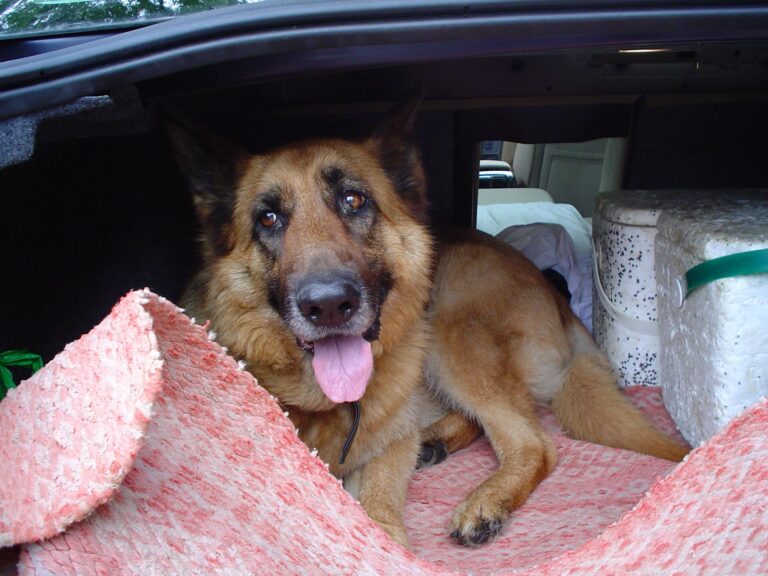

German Shepherd Barking at Visitors Through Windows (What I Learned After Six Embarrassing Months)
There’s a specific kind of mortification reserved for the moment your German Shepherd spots the Amazon delivery person through the front window and reacts as though the house is under siege.
I know it well.
Zeus — my four-year-old German Shepherd — has a window bark that I can only describe as commitment. It’s not a few warning woofs. It’s a full-throated, room-shaking declaration that something outside exists and he has noticed it and he needs everyone, including the delivery person currently backing away toward their van, to know that he has noticed it.
For the first six months we lived in our current house — a house with large front windows that provide Zeus with what I can only describe as premium surveillance real estate — this was a daily, sometimes multiple-times-daily event. The mail carrier. The neighbors walking their dog. Children on bikes. A recycling bin that blew into the yard. The wind, once. I’m fairly sure he barked at his own reflection twice.
I was embarrassed. I was sleep-deprived from the sudden explosive barking. I had apologized to more neighbors than I could count. And I had absolutely no idea how to make it stop.
Here’s everything I learned in the months that followed. The why, the what, and the — finally, eventually — the how.
Why Window Barking Is Such a Perfect Storm for German Shepherds
Before you can address this behavior, you need to understand why it happens with such particular intensity in this breed. Because it’s not random, and it’s not bad luck. It’s the intersection of several things that German Shepherds bring to the table by design.
They were bred to alert. This is the most foundational piece. German Shepherds are working dogs with a long history of performing protective and guarding roles. Detecting and announcing intrusions — real or perceived — is baked into their behavioral profile at a genetic level. When Zeus barks at the mail carrier, he is, from his perspective, doing exactly what he was built to do. He’s performing.
They have extraordinary sensory range. German Shepherds can detect movement, hear sounds, and process environmental information far beyond human capacity. The window isn’t just a view — it’s a constantly refreshing feed of threat-relevant data. The delivery truck three houses down that you haven’t noticed yet? Zeus noticed it when it turned onto the street.
Windows create a particular problem: barrier frustration. When a dog sees something through a window that triggers their alert or protective instinct, they can’t actually do anything about it. They can’t investigate. They can’t intercept. They’re stuck inside, watching a situation they’re constitutionally inclined to respond to, with no outlet for that response except their voice. The bark becomes the only available action, and acting feels better than not acting.
And here’s the killer ingredient: the mail carrier always leaves. The delivery person always drives away. The neighbor always walks past. From Zeus’s perspective, his barking is working. Every single time he sounds the alarm, the perceived threat retreats. This is one of the most perfect inadvertent training loops in dog behavior — the dog is being powerfully reinforced, on a near-daily basis, for barking at the window.
Understanding that last piece changed everything about how I approached it. Zeus wasn’t misbehaving. He was a dog who had learned, through hundreds of repetitions, that barking through the window was the behavior that made things happen. I needed to interrupt that loop.
What the Barking Actually Is (And What It Isn’t)
This matters, because the type of barking shapes the response.
Alert barking: “I’ve noticed something. I’m informing you.” A few barks, often sharp, then the dog looks at you for a response or continues monitoring. This is normal GSD communication. It becomes problematic when it’s excessive or continuous.
Alarm barking: Higher intensity than alert, more sustained. The dog is genuinely worried about what they’re seeing. Body may be stiff, posture tense. This can tip toward reactivity.
Territorial barking: “This is mine and you are approaching it.” Deep, sustained, directed at the person or animal outside. The dog is not asking for your assessment of the situation — they’ve already made theirs.
Demand barking: Sometimes dogs bark at windows not from alarm but from frustration at not being able to get to what they’re seeing — particularly if what they’re seeing is another dog or animal they want to interact with. This sounds different: more whiny, higher pitched, mixed with physical agitation.
Attention-seeking window barking: A dog that has learned that barking at the window produces a reaction from you — any reaction, including “stop it!” — may bark at the window partly because it’s a reliable way to engage you. This is the category nobody mentions, and I’m pretty sure Zeus had a version of it.
I know this because on quiet days, he’d sometimes station himself at the window and bark at… not much. A parked car. A tree. And when I responded — even to say “quiet” — he’d glance at me with an expression that in retrospect reads as satisfied before resuming.
The Role the Window Itself Plays
Here’s something I didn’t consider until I started actually solving the problem: the window is infrastructure for the behavior.
Every time Zeus could access that view, he was in the position to bark. Restricting access to the view was not the ultimate solution, but it was an important management layer while training was happening.
We bought frosted window film for the lower panes of the front windows. Zeus could still see daylight and movement, but the crisp visual information — the specific person, the specific dog, the specific thing that triggered the bark — was gone. He couldn’t identify and fixate on individual targets.
The change was immediate and significant. Not perfect — he still heard things and still alerted — but the full-production theatrical window alarm dropped dramatically because the trigger was no longer available at that intensity.
This was management, not training. I want to be clear about that distinction because it matters. Management prevents the behavior from happening. Training changes the underlying response so the behavior doesn’t need to be prevented. You need both, in parallel, because every time the behavior happens it gets reinforced — so reducing the frequency of the behavior while you do the training work is what actually moves you forward.
The Training Framework That Actually Worked
Let me lay this out clearly, because I tried several things that didn’t work before finding the combination that did.
What Didn’t Work
Shouting “quiet” or “no.” I did this for months. It is completely ineffective for two reasons. One: to Zeus, me joining in vocally reads as me joining in the alarm. I’m just another dog barking. Two: any attention, including a correction, was rewarding the window-barking in the early stages when he was partially using it for engagement. I was, without realizing it, making it worse.
Punitive interruptions. Startling the dog mid-bark with a loud noise or a thrown object. This suppresses the behavior in the moment through fear rather than teaching an alternative. It also poisons the emotional association with the window and with visitors — which, if the underlying issue has any anxiety component, creates reactivity rather than reducing it.
Waiting for the dog to “get used to it.” This is the passive hope that time will sort it out. Time does not sort it out. Each bark-and-retreat cycle is a training session. Left alone, it gets worse.
What Did Work
Teaching an incompatible behavior — specifically, “go to your place.”
This is the single most important thing I did. I spent three weeks teaching Zeus to go to a specific dog bed in response to a cue, completely outside of any window-barking context. We practiced it fifty times a day. Go to place, lie down, get rewarded magnificently. Go to place, lie down, get rewarded magnificently. Until it was automatic — the word hit and he was moving before he’d finished processing it.
Then I began using it at the first sign of window interest — before the bark started, ideally. Zeus orients toward the window: “place.” He goes. He lies down. He gets treats for staying while the trigger outside does its thing and eventually leaves.
What this does is give him a job during the trigger. Instead of bark-and-manage, he has a protocol: something is happening outside, I go to my bed and I stay there and I get rewarded. Over weeks of this, his first response to window activity shifted from alarm to bed. Not completely, not every time — but the trajectory was unmistakable.
Counterconditioning the specific triggers.
This required me to set up situations deliberately. I’d ask my neighbor to walk past our house at a specific time. I’d have a friend drive down the street slowly. Any time I could engineer a trigger, I used it as a training opportunity rather than an interruption.
The sequence: trigger appears, I immediately produce high-value treats before Zeus has time to bark, we do five to ten seconds of happy treat-eating while the trigger is present, trigger passes, treats end. Trigger = treats. Over and over.
What this does is change the emotional response. Zeus’s brain starts to associate the mail carrier with “great things happen” rather than “threat to be announced.” This isn’t suppressing the bark — it’s editing the underlying association that drives it.
Rewarding orientation toward me rather than toward the window.
Any time Zeus noticed something outside and looked at me instead of barking at it, I acted like he’d performed a miracle. Huge reward. Over time, “look at my person when something happens outside” became a habit he offered voluntarily, because it reliably produced excellent results.
This is the behavior I wanted all along — not “stop noticing things outside” (impossible) but “when you notice things outside, look to me for guidance.” That’s a trainable behavior, and it replaces the bark with something functional.
Managing the Energy Underneath the Behavior
One thing I learned from working on Zeus’s window barking is that the intensity of the barking was directly proportional to his overall arousal level at the time.
A Zeus who had been well-exercised — a real workout, not a casual walk — was significantly less explosive at the window. A Zeus who hadn’t been out yet, or who was keyed up from some other stimulation, went nuclear at the slightest provocation.
This is completely consistent with how German Shepherd arousal works across every other behavior context. I’d seen the same pattern with leash pulling — Ranger was harder on the leash on days he’d had no outlet — and with the pacing that builds up when exercise needs aren’t met. The behavior is the overflow valve for energy and arousal that has nowhere else to go.
So the exercise piece wasn’t optional. A proper morning workout — a run, a long fetch session, a demanding training block — consistently reduced the intensity of Zeus’s window reactions by a meaningful degree. Not eliminated, but reduced from “neighbor thinks we have a wolf” to “dog has noticed something.”
For a high-drive breed, arousal management is not supplementary to behavior modification. It’s foundational to it.
When There Are People Actually Visiting (Not Just Passing By)
The window barking at passersby and the barking when people actually approach or enter the house are related but distinct problems, and it’s worth addressing both.
Zeus’s window barking at the door-approaching visitor was particularly intense because of the layering: visual detection through the window, followed by the physical approach, followed by the sound of knocking or the bell. By the time a visitor was actually at my door, Zeus was at a nine out of ten on the arousal scale and the subsequent greeting was its own challenge.
The approach that helped here was breaking the trigger sequence at its earliest point. As soon as Zeus detected someone approaching — usually from his window monitoring — I’d intervene before the bark started. “Place.” Treats for staying while they approached. Then I’d answer the door, have the visitor ignore Zeus completely until he was calm, and only then allow a greeting.
The key insight: visitors who make direct eye contact with a barking German Shepherd, lean toward them, talk to them, or react to their performance in any way are extending and reinforcing the behavior. The visitor who turns away, avoids eye contact, and makes themselves boring to the dog is the visitor who will get a calm greeting fifteen minutes later.
Briefing guests in advance sounds socially awkward. It is, slightly. Do it anyway. “Please ignore him completely when you come in, no matter what he does” is a strange thing to text someone before they visit. It’s also the thing that actually works.
This connects to the whole picture of how Zeus relates to people in and around our home — the protective instinct that drives the window barking is the same instinct behind the guarding behaviors that make German Shepherds simultaneously extraordinary and occasionally exhausting. It’s the same dog. It’s the same drive. The window is just one of its addresses.
The Cat in Our Neighbor’s Yard: A Special Mention
I want to briefly address a subcategory of window barking that deserves its own acknowledgment: when the thing outside the window is an animal rather than a person.
Zeus’s reaction to the neighbor’s cat crossing the yard is categorically different from his reaction to the mail carrier. The mail carrier gets the territorial alarm bark. The cat gets something that starts as a whine and escalates into a full-body, front-paws-on-the-window, frantic declaration that an animal he cannot reach is currently being free.
This is prey drive, not territory. And it requires a different approach — the counterconditioning still applies, but the intensity of the drive underneath means the threshold work has to be even more gradual.
If you’re dealing with window reactivity toward animals specifically — squirrels, cats, other dogs — the work involved in managing prey drive is directly applicable, just conducted through the window rather than on leash. Same principle: stay under threshold, build positive associations, teach an incompatible behavior, and be honest about the timeline.
The Noise Sensitivity Complication
One layer I hadn’t accounted for in Zeus’s window situation was noise.
Some of his barking wasn’t triggered by what he saw but by what he heard before he saw anything. A car door closing two houses down. The recycling truck turning onto the block. Voices he couldn’t locate visually.
This auditory alerting was mixed in with the visual reactivity in a way I didn’t initially separate. Once I did, I realized that some of what looked like window barking was actually sound-triggered alarm behavior that he then ran to the window to resolve — trying to find the visual source of the sound.
For dogs that are also sensitive to sounds, the window isn’t just a visual monitoring post — it’s also where they go to get more information about sounds that have alarmed them. Addressing the sound sensitivity alongside the window behavior gives you a more complete picture and more leverage.
White noise in the main living areas helped dampen the auditory triggers for Zeus significantly — fewer sudden sounds reaching his ears meant fewer alarm-and-investigate sequences, which meant less time spent stationed at the window.
The Specific Challenge With One-Person Households or Primary Bonding
One thing that complicated Zeus’s window behavior was his relationship with who was home.
When I was home, Zeus’s window barking, while intense, was somewhat manageable. When I left and my partner was home alone with him, the barking was reportedly worse — more frequent, more sustained, harder to redirect.
My partner and I eventually realized that Zeus’s protective monitoring of the house ramped up when his primary person — me — wasn’t there. He was, in some sense, guarding the house more intensely in my absence. The window barking was partly a territorial expression and partly an anxiety-adjacent state that came from being the “responsible party” when his person was gone.
This is deeply connected to the single-person bonding dynamic that German Shepherds are so known for. The obsessive attachment to one family member shapes how the dog experiences the home environment even when that family member isn’t present. A dog who is highly bonded to one person may feel more “on duty” when that person is away — more alert, more vocal, more ready to defend.
Solving this required getting my partner more involved in Zeus’s training and care in ways that built his authority and trust with Zeus independently — not just as an extension of my relationship with the dog.
The Behavior Nobody Prepares You For: Barking at Themselves
I mentioned at the start that Zeus barked at his own reflection twice.
I want to address this because it happens, it’s confusing, and it tells you something important.
Dogs don’t recognize themselves in reflective surfaces the way humans do. A German Shepherd seeing their reflection in a window — particularly at dusk, when the inside light makes the window reflective — sees another dog. A large, unfamiliar, intruding dog who is, infuriatingly, mimicking every movement they make.
If your dog is barking at windows at times when there’s clearly nothing outside, check the lighting. A bright interior and dim exterior creates a mirror effect. Moving furniture so the dog’s reflection angle changes, or adjusting interior lighting during those periods, can eliminate this specific trigger without any training required.
Behaviors Connected to the Window Situation
Spending as much time as I have on Zeus’s window behavior has illuminated how connected all of his behaviors are underneath the surface.
The dog who barks at the window is the same dog who growls with passionate enthusiasm during play — high emotional expressiveness is the throughline. The same dog who paws at me persistently when something has upset him is trying to communicate through physical contact what the window bark communicates through sound. And the dog who gets mouthing-intensive during play is showing the same bite-threshold and arousal-management challenges that show up when window excitement escalates.
It’s all one dog. One highly capable, highly expressive, highly driven animal who is doing his best to interact with a world that doesn’t always make sense to him. My job isn’t to suppress the expressiveness. It’s to help him express it in ways that work for both of us.
Where Zeus Is Now
The mail carrier comes at 10:47 AM most mornings. Zeus knows this. He heads to the window around 10:40.
What happens now: he sees the truck, he stiffens slightly, he looks at me. I say “place.” He goes to his bed. He lies down. I give him a treat. The mail carrier puts things in the box. Zeus watches from his bed. The mail carrier leaves. I give Zeus another treat and release him.
Sometimes he whuffs once. Sometimes he doesn’t make a sound. He never does the full siege-alarm bark anymore.
This took four months of consistent work. Four months of managed window access, daily training sessions, embarrassing conversations with neighbors who were enlisted as trigger-exposure volunteers, and enough treats to fill a bathtub.
Was it worth it? Every morning at 10:47, when Zeus goes to his bed on cue and the mail carrier goes about their day in peace, I think yes. Emphatically, unreservedly yes.
Your dog can get there too. It just requires understanding what’s actually driving the behavior and addressing that — not just the noise.
If your German Shepherd’s window barking has escalated to genuine aggression — lunging through screens, breaking through barriers, or behavior that feels dangerous rather than just loud — please work with a certified professional rather than trying to manage it alone. Volume is one thing. Genuine reactivity with aggression risk is another.
Tell me about your window-barking German Shepherd in the comments. I find it enormously comforting to know I’m not alone in this, and I’ll bet you do too.