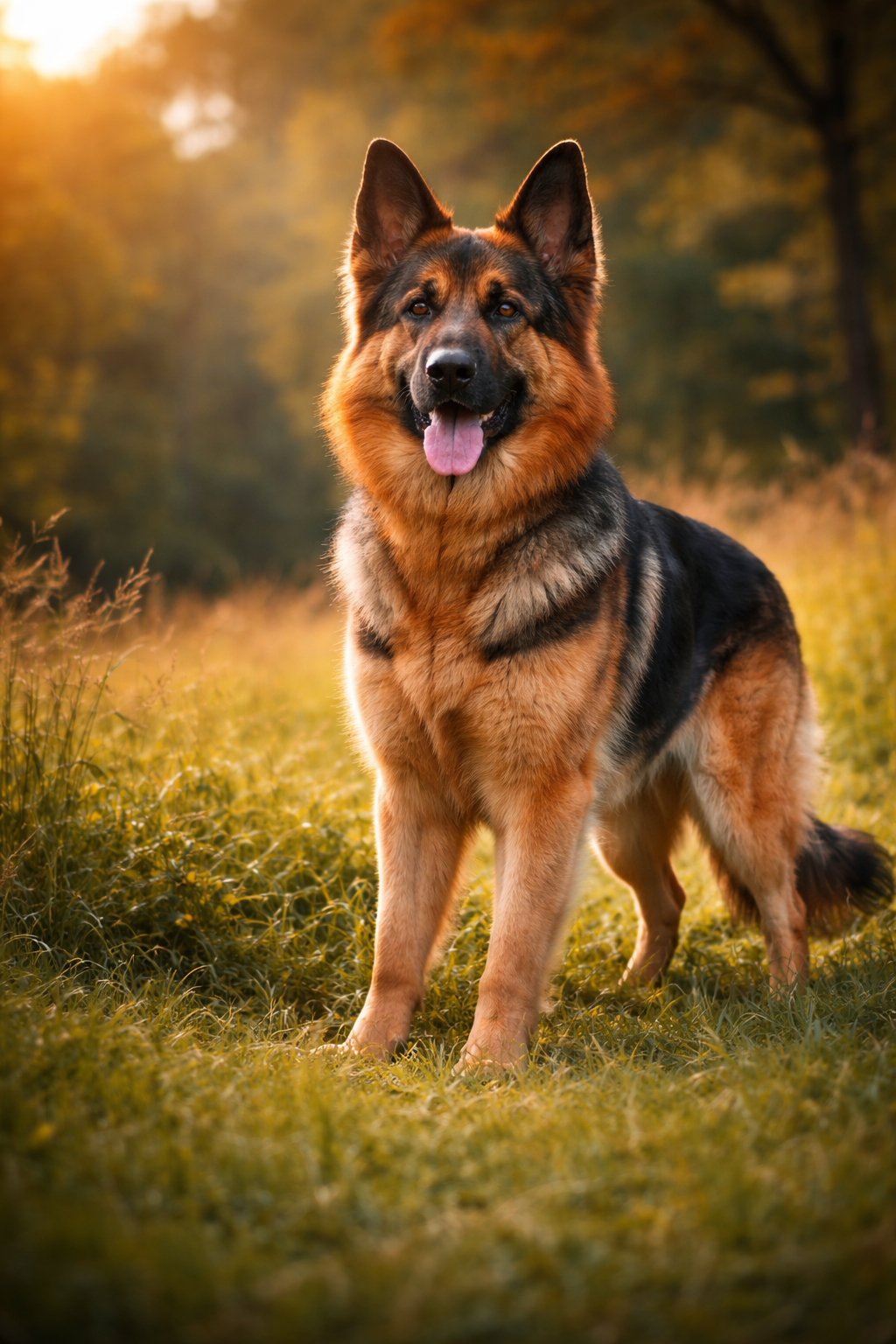
German Shepherd “Silent Herding” Behavior Explained
The first time I noticed Max doing it, I thought he was broken.
We were at a family barbecue, and my nieces and nephews were running around the backyard like wild little humans do.
I was chatting with my brother when I noticed Max moving through the chaos in the most peculiar way.
He wasn’t barking. He wasn’t jumping. He wasn’t even particularly excited.
He was just… circling.
Slowly, deliberately, he moved around the perimeter of the kids’ play area, occasionally stepping in to gently nudge a child who was wandering too far toward the fence.
Then he’d back up, reposition himself, and continue his patrol.
“Is Max okay?” my brother asked. “He’s acting weird.”
But he wasn’t acting weird at all. He was herding. And I had absolutely no idea German Shepherds did this.
That was four years ago, and since then, I’ve learned that what I witnessed that day is one of the most fascinating, deeply ingrained behaviors in the German Shepherd breed.
If you’ve noticed your GSD doing similar things—circling family members, blocking doorways, nudging people with their nose, or positioning themselves to control movement—you’re not witnessing strange behavior.
You’re watching a working dog do exactly what centuries of breeding designed them to do.
Let me share everything I’ve learned about this silent herding behavior, because once you understand it, so much of your German Shepherd’s “quirky” behavior will suddenly make perfect sense.
What Exactly Is Silent Herding?
Silent herding is when a dog uses their body, positioning, and subtle movements to control and direct the movement of people or animals—without barking, nipping, or overt aggression.
It’s called “silent” because unlike some herding breeds that use barking and noise to move livestock, German Shepherds were bred to herd quietly and calmly.
The original German herding dogs (the ancestors of our modern German Shepherds) were expected to move flocks of sheep through villages and towns without causing a disturbance.
Barking sheep through a quiet village at dawn? Not acceptable.
So these dogs learned to herd using “the eye” (that intense stare we talked about before), body blocking, and strategic positioning instead.
Max does this constantly, and once I knew what to look for, I saw it everywhere.
The Classic Moves
There are several signature moves in the silent herding playbook:
The Circle – Walking in wide arcs around a group to keep them contained in one area.
The Block – Positioning themselves between a person and a direction they don’t want them to go.
The Nose Nudge – Gently pushing someone with their nose to redirect their movement.
The Lean – Pressing their body against someone’s legs to guide them in a different direction.
The Cutoff – Moving quickly to get in front of someone who’s moving in an “unacceptable” direction.
Every single one of these is a traditional herding technique, just applied to humans instead of sheep.
My First Real Understanding: The Grocery Incident
I didn’t fully understand what Max was doing until about six months after that barbecue.
I was unloading groceries from my car, making multiple trips from the driveway to the kitchen.
Max stationed himself in the doorway between the garage and the house.
Every time I walked toward the door with bags, he’d step aside to let me through. Every time I turned to go back to the car, he’d move to block my path for just a second.
Not aggressively. Just… there.
Then he’d step aside and let me pass, but he’d immediately move to follow me, staying between me and the street.
I realized what he was doing: he was monitoring my movement pattern and positioning himself to keep me “safe” within his defined territory.
I was the sheep. The house was the pen. And Max was making sure I stayed in the acceptable zone.
It was both hilarious and weirdly touching once I understood it.
The Trainer’s Explanation
I mentioned this behavior to a trainer at our obedience class, and she laughed knowingly.
“Oh yeah, that’s textbook herding behavior,” she said. “German Shepherds are tending dogs. They don’t chase livestock from behind like Border Collies. They patrol the perimeter and keep everything in the right place.”
She explained that German Shepherds were specifically bred for “boundary work”—maintaining a defined space and keeping the flock within it.
They’d create a “living fence” around grazing sheep, constantly moving to prevent strays while keeping predators out.
That’s exactly what Max was doing with me and my groceries.
He’d defined the acceptable boundary (house to car) and was patrolling it to make sure I stayed safe within it.
The Different Types of Silent Herding I’ve Observed
Over the years with Max, I’ve noticed he herds in different ways depending on the situation.
1. Protective Herding
This is the most common type I see, and it’s what Max does with me during our walks.
If we’re walking and someone approaches us, Max will subtly position himself between me and the other person.
He doesn’t bark or show aggression. He just… adjusts his position so he’s in the middle.
If I stop to talk to someone, he’ll sit or stand in a way that creates a physical barrier between me and them.
It’s not that he’s unfriendly (he loves people), but his instinct is to maintain a protective buffer zone around his “flock.”
2. Gathering Herding
This is what I saw at that first barbecue, and I see it all the time now at family gatherings.
When people are scattered around, Max will actively work to bring everyone together into one area.
He’ll move from person to person, sometimes nudging them gently, sometimes just positioning himself in a way that naturally guides people toward the main group.
At Thanksgiving last year, he spent the entire evening herding family members out of the kitchen and into the living room.
Every time someone got up to get a drink or check on food, Max would intercept them on their way back and gently guide them toward the couch where most people were sitting.
My mom thought he just wanted attention, but I knew better. He was gathering his flock into one manageable location.
3. Boundary Enforcement
Max has very clear ideas about where people should and shouldn’t be.
The boundary of our yard? Patrol it constantly during outdoor gatherings.
The edge of the sidewalk during walks? I’m not allowed to step off into the street without him blocking me first.
The hallway at night? He positions himself to monitor who goes where.
I didn’t establish these boundaries. He did. And he takes them very seriously.
4. Movement Direction
This one’s subtle, but once you notice it, you can’t unsee it.
Max will often position himself to influence which direction I walk.
If we’re on a trail and there’s a fork, he’ll move slightly ahead and angle his body toward the path he thinks we should take.
If I start to go the other way, he’ll circle back and try again, more insistently.
He’s not being dominant or controlling. He’s doing what herding dogs do—suggesting the best route for the flock based on his assessment of safety and efficiency.
Sometimes he’s right (there was a rattlesnake on the path he steered me away from once). Sometimes he just has opinions about our walking route.
The Children Factor: When Herding Goes Into Overdrive
If you have kids or frequently have children around, you’ve probably noticed your German Shepherd’s herding behavior intensifies dramatically.
Max treats children like the most important members of his flock—the ones who need the most supervision.
And honestly? He’s not wrong.
The Niece and Nephew Situation
My sister has three kids under age eight, and when they visit, Max transforms into a full-time shepherd.
He follows them everywhere. And I mean everywhere.
If they’re playing in the backyard, he circles them constantly, always keeping them within a defined area.
If one wanders toward the fence, he’ll trot over and gently block their path, or nudge them back toward the others.
If they’re running around (which is always), he positions himself to prevent them from running into the street, the pool area, or anywhere he’s deemed unsafe.
He never barks at them. Never shows aggression. He’s just persistently, consistently present, managing their movement.
The Fascinating Part
What really blows my mind is how good he is at this without any training.
He understands that kids are less predictable than adults. He gives them more space but monitors them more closely.
He’s gentler with them than he is with adults—his nudges are softer, his blocking is less firm.
And he seems to have a sixth sense for when a kid is about to do something risky.
My nephew Jake is a climber. He’ll climb anything—furniture, fences, trees, you name it.
Max has learned this about Jake specifically, and whenever Jake is around, Max stations himself near any climbable surfaces.
The moment Jake starts eyeing the fence or moving toward a tree, Max is there, positioning himself between Jake and the object.
No one taught him this. It’s pure instinct fine-tuned by observation.
The Social Gathering Phenomenon
One of the most noticeable times you’ll see silent herding is during parties or gatherings at your home.
Max becomes a different dog when we have people over.
His energy level increases, his awareness heightens, and he goes into full working mode.
Read more –
German Shepherd and Ticks: Your Complete Guide to Diseases, Protection, and Safe Removal
Traveling With a German Shepherd in the Car: Your Ultimate Road Trip Companion Guide
The Patrol Pattern
During a party, Max establishes a patrol route and sticks to it religiously.
He’ll walk from the living room to the kitchen to the backyard and back again, checking on everyone, monitoring the doors, and making sure his “flock” is safe and accounted for.
If someone new arrives, he investigates immediately, then adds them to his mental roster of people to monitor.
If someone leaves a room and doesn’t return quickly, he’ll go check on them.
The Exit Monitor
This one’s particularly interesting: Max stations himself near the front door during gatherings.
Not blocking it exactly, but positioned so he can see everyone coming and going.
If someone heads toward the door, he’ll get up and follow, making sure they’re actually leaving (not a threat) and ensuring they exit properly.
One friend joked that Max is like a bouncer at a club, checking people in and out.
It’s not far from the truth. He’s managing the flock’s composition, keeping track of who belongs and who’s leaving.
The Walk-Time Herding Dance
Our daily walks are when Max’s herding instinct is most visible, and it took me a while to stop finding it annoying and start appreciating it for what it was.
The Position Control
Max has very specific ideas about where I should walk.
If I’m walking too close to the street, he’ll lean against my legs, gently pushing me toward the inside of the sidewalk.
If I stop to look at my phone, he’ll position himself facing the direction we were walking, essentially encouraging me to keep moving.
If there’s an obstacle ahead (a puddle, broken glass, a sketchy-looking person), he’ll try to steer me around it by angling his body and creating a natural path.
The Other Dog Protocol
When we encounter other dogs on walks, Max’s herding behavior becomes strategic.
If the dog is friendly and I stop to chat with the owner, Max will position himself to keep both me and the other dog within his sight line.
He creates a triangle formation: him at one point, me at another, the other dog at the third.
If either me or the other dog moves too far from this formation, Max adjusts to maintain the triangle.
It’s like watching a sheepdog maintain visual control of multiple animals at once.
The Recall Resistance
Here’s something I struggled with until I understood the herding instinct: Max is sometimes reluctant to come when called if he thinks his flock isn’t safely together.
If I’m at the dog park and I call Max while there are still other dogs running around, he’ll hesitate.
Not because he’s being disobedient, but because his instinct is telling him he can’t leave his “post” until everyone is safely contained.
Once I understood this, I changed my approach. Instead of getting frustrated, I either wait until the park clears out a bit, or I physically go to where Max is and walk back with him.
Works much better.
The Nighttime Patrol
If you have a German Shepherd, you’ve probably noticed they take their nighttime duties very seriously.
Max has a whole nighttime routine that’s entirely self-directed and completely based on herding instinct.
The Bedroom Rounds
Every night, without fail, Max does a circuit of the bedrooms.
First mine, then the guest room, then back to the hallway.
He’s checking on his flock, making sure everyone’s where they should be and safe for the night.
If I have a guest staying over, he adds an extra check to his route—visiting their room more frequently than the empty guest room.
The Hallway Station
After his rounds, Max stations himself in the hallway, positioned so he can see both my bedroom door and the top of the stairs.
He’s created a checkpoint. Nothing gets past him without him knowing about it.
If I get up in the night for any reason, he’s immediately alert, watching to make sure I’m okay and tracking where I go.
If a guest gets up to use the bathroom, same thing. He monitors the movement but doesn’t interfere unless something seems wrong.f
The Morning Assembly
In the morning, Max has a routine for getting the household moving.
He’ll come to my room first, wake me up (usually with the stare), then wait for me to get up.
If I don’t get up quickly enough, he’ll go check the other rooms, then come back to me, as if to say, “Everyone else is still asleep too, but we should probably get this day started.”
Once I’m up and moving, he relaxes. The flock is active, and his morning herding duty is complete.
The Subtle Corrections: When Your GSD Thinks You’re Wrong
This is one of the more amusing aspects of living with a herding dog.
Max will sometimes try to “correct” my behavior if he thinks I’m making a poor decision.
The Route Disagreement
I mentioned earlier how Max sometimes tries to steer me on walks, but it goes deeper than that.
If I try to take a route he’s decided is unsafe or inefficient, he’ll resist.
He’ll slow down, lag behind, or pull slightly in the other direction.
It’s subtle—not pulling hard or being stubborn, just making it clear he has a different opinion.
There was a period where construction blocked our usual walking route. I tried to go a different way, and Max resisted every single time for two weeks.
Then I discovered there was a loose, aggressive dog on that street that had been reported multiple times.
Max knew. He’d sensed or seen something I’d missed, and he was trying to keep his flock away from danger.
I listened after that.
The Guest Management
When we have visitors, Max sometimes tries to “manage” how people interact with me.
If someone’s getting too close or too animated (especially if they’re gesturing), Max will position himself between us.
Not aggressively—just inserting himself into the space.
If a conversation is getting heated (even just friendly debate), Max will sometimes interrupt by nudging one of us or positioning himself to physically separate us slightly.
He’s de-escalating what he perceives as potential conflict, keeping the flock harmonious.
It’s actually a recognized behavior in herding dogs—they naturally try to prevent confrontation within the group.
The Car Ride Protocol
Oh man, car rides with a herding dog are an experience.
Max treats every car ride like a mobile herding operation, and he has very specific rules about how it should work.
The Loading Process
When we’re loading into the car, Max insists on a specific order.
He won’t get in until I do. He waits, watching me, making sure I’m safely in the vehicle before he jumps in.
If there are other people coming, he’ll wait until everyone is loaded before settling down.
He’s doing a headcount, essentially, making sure all members of the flock are accounted for before the vehicle moves.
The Drive Monitoring
During drives, Max positions himself in the back seat where he can see both me (the driver) and the road ahead.
He’s monitoring the route, the traffic, and my behavior.
If I make a sudden movement or sharp turn, he shifts his weight to maintain balance but keeps his eyes on the situation.
If we stop somewhere and I get out, leaving him in the car, he moves to a window position where he can watch both the car and wherever I’ve gone.
He’s maintaining visual contact with his flock member even when separated.
The Arrival Anxiety
This one used to puzzle me: Max would get anxious when we’d arrive at a destination but I wasn’t immediately getting out of the car.
I’d be checking my phone or gathering my things, and he’d start pacing in the back seat.
A trainer explained that from his perspective, we’ve arrived at the destination (the new “pasture”) and I should be moving to secure the area, but instead I’m just sitting there.
It triggers his instinct that something’s wrong—why isn’t the shepherd moving the flock to safety?
Now I’m more mindful about this. I either prepare my stuff before we arrive, or I give him a “settle” command to let him know the delay is intentional.
The Multi-Pet Household Dynamic
If you have other pets, your German Shepherd’s herding behavior can become really complex and fascinating.
I don’t have other dogs, but I did cat-sit for a friend for two weeks once, and Max’s response was enlightening.
The Cat Situation
My friend Sarah’s cat, Mochi, is an adventurous, boundary-pushing feline who has no concept of personal safety.
Within an hour of Mochi arriving at my house, Max had appointed himself as her personal shepherd.
He followed her everywhere. When she tried to jump onto the kitchen counter (where she wasn’t allowed), Max would position himself in front of the counter and block her.
When she tried to sneak into rooms that were off-limits, Max would herd her back to the main living area.
He was gentler with her than he is with humans—clearly recognizing she was smaller and more delicate—but he was also more persistent.
Mochi would try to outsmart him (cats gonna cat), and it became this ongoing chess match of feline cunning versus canine determination.
The Integration Process
What really impressed me was how Max integrated Mochi into his existing flock management system.
He expanded his patrol route to include the areas where Mochi liked to hang out.
He adjusted his nighttime routine to check on her sleeping spot.
He even started positioning himself between Mochi and the front door when delivery people came, protecting her the same way he protects me.
He’d added a new member to his flock and adapted his entire herding strategy accordingly.
Sarah jokes that Mochi came back from my house with better manners than when she left.
Max had literally herded her into better behavior.
When Silent Herding Becomes a Problem
I need to be honest here: while herding behavior is natural and often endearing, it can sometimes become problematic if not properly managed.
The Over-Herding Issue
Some German Shepherds can become obsessive about herding, to the point where it interferes with normal life.
I’ve seen GSDs who won’t let family members move freely around the house, who constantly redirect children, or who become anxious when they can’t control everyone’s movement.
This isn’t healthy for the dog or the family.
The Boundary Disputes
Max once went through a phase where he was too aggressive about enforcing boundaries he’d created.
He’d block me from going into certain rooms or wouldn’t let guests move freely around my own house.
I had to work with a trainer to help him understand that while his herding instinct was appreciated, I was still the one who set the actual rules.
The Stress Factor
Constant herding can be stressful for a dog, especially in chaotic households or situations where they can’t effectively “control” their flock.
Max gets visibly anxious at really large gatherings where too many people are moving in too many directions.
He’ll try to herd everyone, realize he can’t, and then become stressed and overstimulated.
I’ve learned to either limit the size of gatherings or give Max a break in a quiet room when things get too chaotic.
How to Work WITH the Herding Instinct
The key to living successfully with a herding German Shepherd isn’t to eliminate the behavior—it’s to channel it appropriately.
Give Them a Job
Max is happiest when he has a clear job to do.
I’ve channeled his herding instinct into useful tasks:
- “Find the kids” means go check on wherever the children are playing
- “Watch the door” gives him permission to monitor people coming and going
- “Keep us together” on family walks means he can actively herd everyone into a group
Having clear commands for his herding behaviors helps him understand when it’s appropriate and when it’s not.
Establish Clear Boundaries
I had to teach Max that while herding is fine, there are limits.
He doesn’t get to block doorways when I’m trying to leave for work.
He doesn’t get to herd guests who don’t want to be herded.
He doesn’t get to redirect me when I’ve made a clear decision about where I’m going.
This took training and consistency, but it was worth it.
Provide Mental Stimulation
Herding is mentally exhausting work for dogs. They’re constantly observing, analyzing, and making decisions.
I make sure Max gets plenty of mental stimulation through training, puzzle toys, and challenging activities.
A mentally tired herding dog is much less likely to over-herd or develop obsessive behaviors.
Recognize and Reward Good Herding
When Max uses his herding instinct appropriately—like gently guiding my nephew away from the pool edge or alerting me to someone at the door—I praise him.
This reinforces that the behavior itself isn’t bad; it’s about context and appropriateness.
Know When to Redirect
If Max starts herding in situations where it’s not helpful or wanted, I redirect him to another activity.
“Leave it” followed by a command to do something else (sit, down, get your toy) helps him shift out of herding mode.
The Training Advantage
Here’s something cool: once you understand and work with your GSD’s herding instinct, training becomes much easier.
They’re Watching Everything
Herding dogs are masters of observation. They’re watching your every move, every gesture, every subtle shift in body language.
This makes them incredibly responsive to training—IF you’re consistent and clear.
Max picks up on new commands faster than any dog I’ve ever worked with, because he’s genetically programmed to watch for and respond to human cues.
They Want Direction
Herding dogs aren’t trying to be dominant or take over. They’re looking for direction from their human.
When I’m clear and confident in my commands, Max is happy to follow. When I’m wishy-washy or inconsistent, he’ll try to make decisions himself (which usually means herding).
Understanding this dynamic transformed our training relationship.
Channel It Into Sports
Max excels at activities that tap into his herding instinct:
- Rally obedience (following precise movement patterns)
- Agility (controlling movement through space)
- Tracking (using his nose and focus simultaneously)
- Protection sports (controlled guarding and positioning)
If you have a herding GSD and haven’t tried any of these activities, I highly recommend it. It gives them an outlet for their natural behaviors in a structured, appropriate way.
The Unexpected Benefits
Living with a herding German Shepherd has some unexpected upsides that I’ve come to really appreciate.
You’re Never Alone
Some people might find this claustrophobic, but I find it comforting: I always know where Max is, and he always knows where I am.
We exist in this constant awareness of each other, and it creates a deep bond.
Built-In Safety Monitor
Max’s herding instinct means he’s constantly assessing the environment for threats or hazards.
He’s noticed things I would have missed—loose dogs approaching, sketchy people hanging around, potential dangers in the environment.
His vigilance has kept me safer more times than I can count.
The Ultimate Party Host Assistant
When I have gatherings, Max helps in ways most people don’t even notice.
He keeps conversations flowing by moving between groups.
He alerts me when someone needs attention or seems uncomfortable.
He monitors the door so I know when people arrive or leave.
He’s like having a co-host who never gets tired or distracted.
Kid Magnet and Babysitter
Children are drawn to Max because he’s so gentle and attentive with them.
And parents appreciate that he naturally monitors their kids’ safety without being asked.
I can’t count how many times Max has gently redirected a child away from something dangerous before the parent even noticed the risk.
He’s the world’s most dedicated unpaid babysitter.
Understanding the “Why” Changes Everything
The biggest shift in my relationship with Max came when I stopped seeing his herding behaviors as quirks or problems and started understanding them as expressions of his genetic heritage.
He’s not being weird when he circles my family at gatherings. He’s being a German Shepherd.
He’s not being clingy when he follows me from room to room. He’s doing his job.
He’s not being difficult when he tries to steer me away from certain routes or people. He’s protecting his flock.
Once I understood the “why,” I could work with it instead of against it.
The Respect Factor
I have so much more respect for Max now that I understand what his brain is doing.
He’s not just a pet who hangs around the house. He’s a working dog with centuries of genetic programming telling him to monitor, protect, and manage his flock.
Even without formal training, even without sheep, even in suburban life, those instincts are strong and real.
Honoring that—giving him appropriate outlets, recognizing his behaviors for what they are, and working with his nature instead of against it—has made both our lives better.
The Bottom Line
German Shepherd silent herding behavior is not a bug; it’s a feature.
It’s what these dogs were designed to do, and it’s deeply woven into who they are as a breed.
Your GSD who circles your kids at the park? Not broken. Herding.
Your GSD who positions themselves between you and strangers? Not aggressive. Herding.
Your GSD who monitors everyone’s movement during family gatherings? Not anxious. Herding.
Your GSD who nudges you away from certain directions on walks? Not controlling. Herding.
Understanding this behavior helps you:
- Appreciate your dog’s instincts instead of fighting them
- Channel the behavior into appropriate outlets
- Recognize when it’s becoming problematic
- Work more effectively with your dog’s natural tendencies
- Build a stronger bond based on understanding
Max is currently doing his evening patrol—circling the living room where I’m writing this, checking the doors, monitoring the windows.
To an outsider, it might look obsessive or strange.
To me, it looks like a German Shepherd being exactly what a German Shepherd should be: a vigilant, devoted, hard-working dog taking care of his flock.
And I happen to be his flock.
Which makes me one lucky sheep.
Does your German Shepherd herd? What behaviors have you noticed? I’d love to hear your stories in the comments!